Highlights
- Physical therapy can help restore movement, strength, balance, and everyday function after surgery.
- Recovery plans should reflect the procedure, surgeon’s restrictions, and each patient’s abilities.
- Early therapy often emphasizes safe movement, mobility, and basic daily activities.
- Progressive exercise can rebuild strength while respecting the body’s healing process.
- Home exercises can reinforce clinic sessions and support steady progress between appointments.
- Communication among patients, therapists, and surgeons helps keep rehabilitation aligned with medical guidance.
How Can Physical Therapy Help After Surgery?
Physical therapy can give patients a path from early healing toward everyday activity. Surgery may correct a medical problem, but the body still needs time and progressive movement to rebuild function.
A physical therapy clinic can evaluate mobility, strength, balance, pain, swelling, and movement patterns before creating a rehabilitation plan. Therapy helps patients work within precautions established by their surgeon while gradually increasing safe activity. MedlinePlus explains that rehabilitation can help people regain or improve abilities needed for daily life, including after major surgery. That matters because postoperative recovery involves more than healing an incision. It can also involve restoring comfortable movement, confidence, and independence.
Why Is an Individualized Recovery Plan Important?
An individualized recovery plan is important because surgeries, patients, and healing timelines differ. A knee replacement, rotator cuff repair, spinal procedure, or abdominal surgery may involve different restrictions and goals. During an evaluation, a therapist can review the surgeon’s instructions, assess current limitations, and identify priorities such as walking, climbing stairs, reaching, returning to work, or completing household tasks. The American Physical Therapy Association explains that physical therapy can help people prepare for and recover after surgery while supporting a return to function. A plan can change as swelling decreases, motion improves, and strength returns. That flexibility supports progress without ignoring healing or procedure-specific precautions.
What May Happen During Early Postoperative Therapy?
- Early postoperative therapy usually focuses on safe movement, symptom management, and basic function rather than intense exercise.
- Patients may practice transfers from beds, chairs, or other surfaces without unnecessary strain.
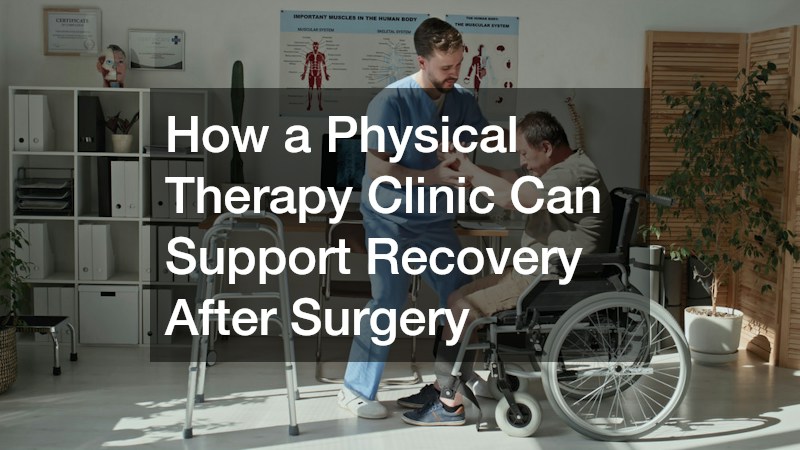
- A therapist may teach the correct use of a walker, crutches, cane, brace, or prescribed equipment.
- Gentle range-of-motion activities may be introduced when appropriate for the procedure and healing stage.
- Positioning, elevation, and movement strategies may help patients manage stiffness and swelling.
- Short walking sessions can emphasize posture, balance, and movement quality instead of speed.
- Patients can review movements that should be limited and learn which changes should be reported.
- These steps provide direction when patients may be unsure how much movement is appropriate.
How Does Therapy Rebuild Strength and Mobility?
Therapy rebuilds strength and mobility by increasing physical demands gradually as healing allows. Muscles can weaken after surgery because pain, swelling, immobilization, or activity restrictions reduce normal use. Joints may become stiff, and patients sometimes develop compensating movement patterns. A therapist can select exercises that target movements most relevant to recovery, then modify resistance, repetitions, or complexity over time. Work may progress from gentle mobility and muscle activation to strengthening, balance, endurance training, and functional movements. The sequence depends on the operation and the patient’s response. This progression helps patients practice movement without treating recovery like a race while giving the therapist opportunities to identify difficulty before demanding activities are introduced.
How Can a Clinic Support Safe Progress at Home?
- A clinic can support progress at home by turning recovery goals into specific actions between visits.
- Home exercises may address mobility, strength, balance, or endurance based on the healing phase.
- Walking or activity goals can increase gradually rather than through sudden jumps in intensity.
- Patients may practice safer ways to navigate stairs, bathrooms, bedrooms, vehicles, or work areas.
- Instructions can reinforce restrictions involving lifting, weight bearing, joint movement, or assistive devices.
- Tracking pain, swelling, fatigue, or functional changes can help patients describe their response to activity.
- Therapists can review exercise form, frequency, and progression so the home program remains appropriate.
- Patients can learn which questions belong with the therapist and which concerns require the surgeon.
- Consistent home practice can reinforce the work completed during appointments.
Why Does Communication With the Surgical Team Matter?
Communication with the surgical team matters because rehabilitation must remain consistent with the medical plan. Surgeons may establish restrictions involving weight bearing, lifting, joint motion, bracing, wound protection, or timelines for activities. A physical therapist uses those instructions when selecting exercises and deciding when treatment can advance. Patients also benefit from knowing which concerns belong in therapy and which require medical follow-up. The American College of Surgeons recommends gradually increasing activity and contacting a surgeon about concerning symptoms such as worsening pain, fever, or wound changes. A physical therapy clinic does not replace postoperative medical care, but it can help patients apply recovery instructions to daily movement and communicate functional changes.
How Can Therapy Help Patients Return to Everyday Activities?
Physical therapy can help patients return to everyday activities by connecting exercises to movements they need outside the clinic. Building strength is useful, but recovery often feels more meaningful when patients can walk farther, use stairs, get dressed, return to work, or resume recreation. Therapists may add task-specific practice as patients advance, such as lifting light objects, improving balance, increasing walking endurance, or rehearsing movements required for a job or hobby. Progress is rarely perfectly linear, so treatment may be adjusted when fatigue, stiffness, or new functional demands appear. By measuring function and matching treatment to meaningful goals, therapy can help patients move from basic postoperative mobility toward greater independence.
Why Is Physical Therapy a Strong Part of Surgical Recovery?
Physical therapy is a strong part of surgical recovery because it combines assessment, progressive exercise, functional training, education, and ongoing adjustment. Patients may leave the hospital with restrictions and general instructions, but applying those directions in everyday life can be difficult. Working with a physical therapy clinic gives patients a place to practice, ask questions, measure progress, and adapt rehabilitation as abilities change. Recovery also depends on participation outside the clinic, including following medical precautions and completing appropriate home exercises. No therapy plan can guarantee a specific timeline. However, coordinated rehabilitation can provide clearer goals and safer ways to work toward them. With consistent effort, appropriate medical guidance, and thoughtful progression, physical therapy can help turn surgical healing into a meaningful return to daily life.